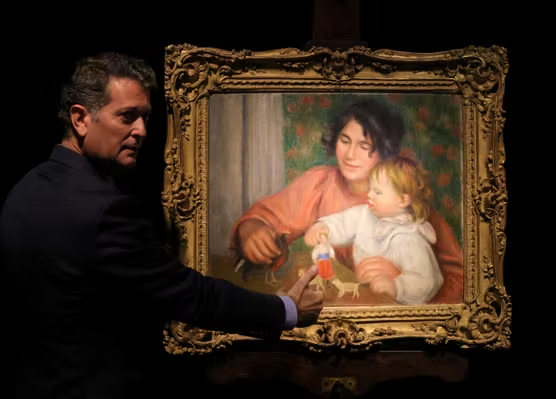
A previously unknown painting by French Impressionist master Pierre-Auguste Renoir has sold for €1.8 million at a Paris auction, marking the emergence of a rare, privately held work that had never been exhibited or offered for sale.
The canvas, L’enfant et ses jouets – Gabrielle et le fils de l’artiste, Jean, was presented on Tuesday, November 25, by the Drouot auction house, which confirmed the final hammer price to Agence France-Presse (AFP).
Painted between 1890 and 1895, the oil portrait depicts Renoir’s second son, Jean Renoir, as a toddler seated beside Gabrielle Renard, the family’s beloved nanny who appears in numerous works by the artist.
The intimate domestic scene was long thought lost, having remained outside public view since its creation. The painting belonged to Jeanne Baudot, Jean’s godmother and one of Renoir’s students, who kept the work in her private collection until her death. It was then passed down to her inheritors, who opted to place it at auction this week.
According to Pascal Perrin, a leading Renoir specialist who examined the work, the painting’s remarkable state of preservation contributed significantly to its appeal among collectors.
“The exceptional condition of the work, which has undergone no restoration, sets it apart from many Renoir canvases of the same period,” Perrin noted during the auction preview. He described the canvas as a rare window into Renoir’s family life at the height of his artistic maturity.
The painting had been initially valued between €1 million and €1.5 million, but swift bidding pushed the price to €1.8 million, ultimately secured by an international buyer whose identity was not disclosed by Drouot. The sale underscores the enduring global demand for Impressionist works, especially those with strong provenance and familial significance.
The rediscovery of L’enfant et ses jouets comes at a time of heightened interest in the top tier of the art market. Just two nights before the Renoir auction, a Gustav Klimt canvas sold for $236.4 million in New York, becoming the second-most expensive artwork ever sold at auction.
While the Renoir sale was far more modest in scale, experts say it nevertheless reflects a market eager for fresh-to-market masterpieces with compelling personal narratives.
Jean Renoir, born in 1894, would later become one of France’s most celebrated filmmakers, earning a Lifetime Achievement Academy Award in 1975 for a career that profoundly influenced modern cinema.
Among his most acclaimed works is La Grande Illusion, the 1937 film that follows two French officers attempting to escape a German prisoner-of-war camp during World War I. The rediscovered painting offers a glimpse of the artist’s son decades before his rise to cinematic fame.
For art historians, the emergence of this portrait adds a new piece to the puzzle of Renoir’s late 19th-century output. The presence of Gabrielle Renard, often credited with nurturing young Jean’s early imagination, deepens the painting’s historical resonance.
Renard, a cousin of Renoir’s wife Aline, appears frequently in Renoir’s domestic scenes and played an influential role in shaping Jean’s artistic sensibilities. Her inclusion in this newly surfaced canvas enriches ongoing scholarship into the intertwined lives of the Renoir family.
Drouot officials emphasized that the sale reflects the auction house’s longstanding reputation for bringing rare and previously unknown works to light.
“This discovery is precisely the type of event the art world hopes for – a significant work, preserved in impeccable condition, with direct ties to one of France’s most important artistic families,” a spokesperson said following the sale. The painting’s reappearance also highlights the role of private collections in safeguarding cultural history.
Many works by major Impressionist painters remain tucked away in family estates or private holdings, emerging only when inheritance successions or archival reorganizations bring them to attention. Experts believe that similar discoveries may still be waiting in storerooms and attics across Europe.
As L’enfant et ses jouets begins its journey into a new private collection, the art world continues to reflect on the significance of its re-emergence. For admirers of Renoir, the sale represents both a celebration of the painter’s enduring legacy and a reminder of the intimate, familial moments that shaped his work.
The painting, unseen for over a century, now reclaims its place within the broader narrative of Impressionist art—a quiet domestic masterpiece returned to the spotlight.