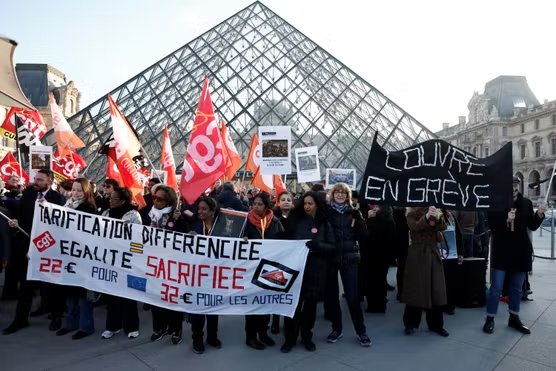
The Louvre Museum, the world’s most visited cultural institution, was forced to close on Monday after workers launched a strike to protest what they describe as worsening working conditions and chronic understaffing. The action left thousands of visitors disappointed outside the Paris landmark.
Staff gathered beneath the museum’s iconic glass pyramid, blocking the main entrance while holding banners and chanting slogans. Security personnel turned tourists away as the museum confirmed it would remain closed for the day due to the industrial action.
Workers say overcrowding, staff shortages and management decisions have made their jobs increasingly difficult. With France entering the busy Christmas holiday season, unions argue the situation has reached a breaking point for employees tasked with managing record visitor numbers.
“We are angry,” said Elise Muller, a security guard who joined the protest. She said staff disagreed with how the museum was being run, adding that frontline workers were bearing the consequences of years of underinvestment and operational strain.
The strike follows a string of incidents that have heightened concerns about safety and management at the Louvre. Nearly two months ago, the museum was embarrassed by a daylight robbery in which crown jewels valued at more than $100 million were stolen, raising questions about security measures.
At a general assembly held before the walkout, around 400 employees voted unanimously to strike, according to the CGT and CFDT unions. Union representatives said the action could be renewed following further meetings later this week.
Christian Galani, a representative of the hard-left CGT union, said the strike had unusually broad backing across the museum’s workforce of about 2,200 people. He noted that participation extended well beyond security and front-of-house staff.
“This time, we have scientists, documentarians, collections managers and even curators planning to strike,” Galani said, describing the mobilisation as a sign of widespread frustration within the institution.
Outside the closed museum, visitors expressed a mixture of disappointment and sympathy. For many tourists, a visit to the Louvre is the highlight of a trip to Paris, and the sudden closure disrupted carefully planned itineraries.
Minsoo Kim, a 37-year-old visitor from Seoul on his honeymoon, said seeing the Mona Lisa was the main reason for his trip. “We’re very disappointed,” he said, standing among crowds gathered outside the gates.
Others said they understood the workers’ demands despite the inconvenience. Natalia Brown, a tourist from London, said the timing was unfortunate but acknowledged that staff had legitimate concerns about their working conditions.
Rachel Adams, a visitor from Utah, said she had heard about the planned strike before arriving. She criticised the museum’s management, saying that an institution generating significant revenue should be able to invest properly in staffing and infrastructure.
Union officials argue that overcrowding has become a daily challenge at the Louvre, with staff struggling to manage visitor flows while ensuring the safety of people and priceless artworks. They say additional hiring and better organisation are urgently needed.
The museum, which is closed on Tuesdays, was due to reopen later in the week, pending the outcome of further staff meetings. Management has not publicly commented in detail on the strike or the workers’ demands.
The closure highlights broader tensions within France’s cultural sector, where workers have increasingly voiced concerns about workload, safety and funding. For the Louvre, the dispute comes at a sensitive time, as authorities seek to protect both its global reputation and the millions of tourists who pass through its doors each year.