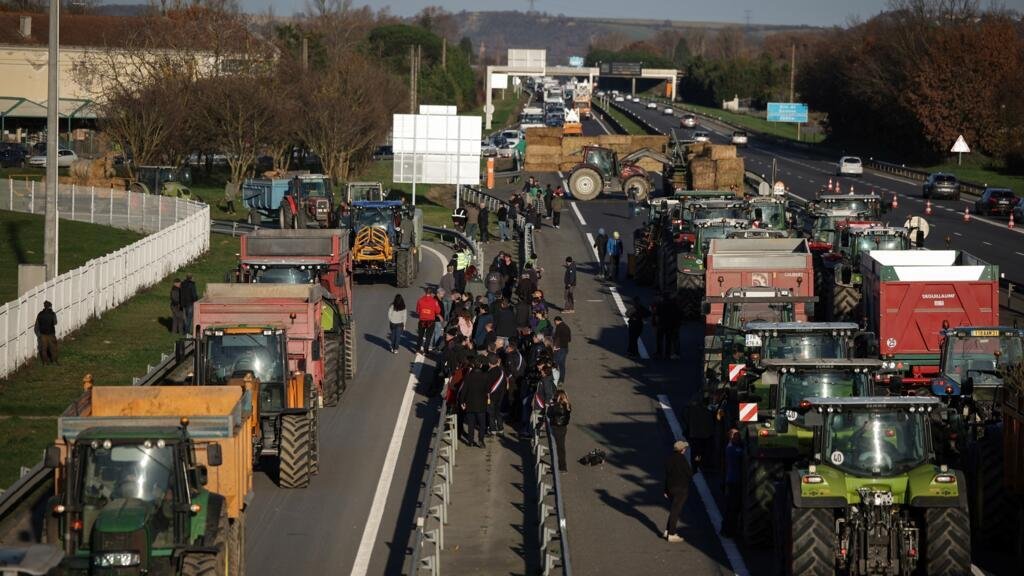
Traffic disruptions continued to intensify across France’s Rhône region on Tuesday, particularly south of Lyon, as farmers maintained road blockades for a second consecutive day. The protests, driven by anger over agricultural policies and disease management, have caused widespread delays and forced authorities to divert traffic on several key routes.
According to local media and traffic services, the metropolitan road M7 has been completely blocked in both directions near Pierre-Bénite. Dozens of tractors and demonstrators have occupied the roadway, effectively cutting off one of the main transport arteries linking Lyon to the south.
Protesters at the Pierre-Bénite site have also established a makeshift camp, signaling their intention to remain in place for several days if necessary. Organizers said the occupation would continue until concrete commitments are made by the government regarding farmers’ demands.
Further north, congestion has spilled over onto connecting routes, compounding delays for commuters and freight transport. Road authorities confirmed additional disruptions at the A450 and A7 junction, where partial lane closures and slow-moving traffic have significantly reduced capacity.
Local officials have activated diversion plans in an attempt to ease the situation, though traffic services warned that alternative routes are also becoming saturated. Motorists have been urged to avoid the affected areas altogether and to postpone non-essential travel where possible.
The protests are primarily focused on the government’s handling of an outbreak of contagious nodular dermatitis affecting cattle herds. Farmers argue that current measures are unclear, inconsistent, and financially damaging, particularly for small and medium-sized livestock operations.
Contagious nodular dermatitis is a viral disease that affects cattle, causing skin lesions, fever, and reduced productivity. While authorities have sought to contain the outbreak through surveillance and control measures, farmers say compensation mechanisms and preventive strategies remain insufficient.
Beyond the disease outbreak, demonstrators are also voicing frustration over rising production costs. Higher fuel prices, increased feed expenses, and stricter regulatory requirements have, according to farming unions, severely squeezed profit margins over the past year.
Many farmers warn that without additional financial support or policy adjustments, more operations could be forced to shut down. They argue that the current situation threatens not only individual livelihoods but also the long-term sustainability of French agriculture.
Trade policy has emerged as another major flashpoint in the protests. Farmers are particularly opposed to ongoing free trade negotiations, including the agreement between the European Union and Mercosur countries in South America.
Agricultural groups claim that such agreements expose French farmers to unfair competition from producers operating under less stringent environmental and animal welfare standards. They fear an influx of cheaper imports could further undermine domestic production.
In the Rhône region, the impact of the blockades has been felt well beyond the agricultural sector. Logistics companies have reported delivery delays, while local businesses reliant on road transport say disruptions are affecting daily operations.
Emergency services have remained on alert to ensure access routes remain available, though authorities acknowledged that prolonged blockades could complicate response times if the situation persists.
Government representatives have so far called for calm and dialogue, emphasizing the need to balance public health, economic stability, and farmers’ concerns. However, no immediate breakthrough has been announced, and talks with protest leaders are reportedly ongoing.
As tractors remain parked across major roads and demonstrators hold their ground, uncertainty hangs over the region. With farmers signaling they are prepared for a prolonged standoff, residents and travelers around Lyon are bracing for continued disruption in the days ahead.