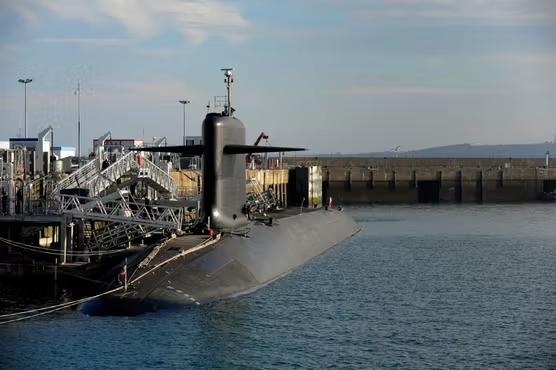
France has opened a judicial investigation following the detection of multiple unidentified drones over one of its most sensitive military installations, the Ile Longue naval base near Brest in western Brittany. The base hosts France’s nuclear-armed submarines, a central pillar of the country’s strategic deterrence.
The flyover occurred late Thursday, December 4, and involved at least five drones, according to security sources. The following day, prosecutors confirmed that a formal judicial inquiry had been launched to establish the nature, origin, and possible intent behind the intrusion.
The incident immediately raised alarms within the French defense establishment due to the strategic importance of the site. Ile Longue is heavily guarded and subject to some of the strictest security protocols in the country, including reinforced airspace restrictions.
Military personnel stationed at the base reportedly deployed a jamming device in an attempt to intercept or disrupt the drones. While the defensive measure was triggered, officials declined to comment on whether the drones were neutralized or successfully driven away.
French Defense Minister Catherine Vautrin emphasized caution when addressing the matter publicly. Speaking during a visit to Mérignac in southwestern France, she reiterated that France would not assign responsibility without conclusive findings from the investigation.
“Any unauthorized flyover of a military site is illegal,” Vautrin said. “Once such an incident occurs, a complaint is filed and an investigation is opened. It is for that investigation to determine what actually happened.”
Her remarks reflect a consistent policy adopted by French authorities in recent months. Since late September, several similar drone sightings have been reported over military and industrial sites linked to national defense.
Among them were flyovers at the Mourmelon military camp in northeastern France, the Eurenco explosives powder plant in Bergerac, and along a route used by Leclerc tanks returning from a NATO exercise near the eastern city of Mulhouse.
In each of these cases, authorities refrained from public speculation over whether the drones were operated by foreign states, non-state actors, activists, or criminal groups. Officials argue that premature attribution could escalate tensions or undermine the credibility of security responses.
Security analysts note that drones pose an increasing challenge to military forces across Europe. Advances in commercial drone technology have made sophisticated equipment cheaper, quieter, and easier to deploy, even in tightly controlled airspace.
“The real concern is not just espionage, but the demonstration effect,” said one defense expert familiar with French military doctrine. “Repeated intrusions test response times, reveal vulnerabilities, and erode the perception of absolute security around strategic sites.”
French law strictly bans drone flights over military facilities, with violations carrying heavy penalties, including prison sentences and substantial fines. However, identifying operators has proven difficult, particularly when drones are launched from remote or mobile locations.
The Ministry of the Armed Forces has increased cooperation between military units, gendarmerie, and judicial authorities to improve detection and response capabilities. Additional investments in counter-drone technologies are also underway, officials say.
Despite rising public concern, government sources insist that no immediate threat to France’s nuclear deterrent has been identified. They stress that safety mechanisms and layered defenses remain fully operational.
As investigators work to trace the drones’ origins, officials maintain their low-profile stance. For now, the priority remains gathering evidence rather than issuing accusations, even as drone incursions continue to challenge Europe’s traditional models of military security.
This article was created using automation technology and was thoroughly edited and fact-checked by one of our editorial staff members