France has unveiled an updated national strategy outlining how the country intends to reach carbon neutrality by 2050, placing the gradual phaseout of oil and gas at the heart of its climate ambitions.
The revised plan, known as the third National Low-Carbon Strategy (SNBC-3), was released on Friday, December 12, coinciding with the tenth anniversary of the Paris Agreement, the global climate accord signed in 2015.
French officials described the roadmap as a decisive step toward aligning national policy with long-term climate goals, even as international climate diplomacy faces mounting difficulties. Under the updated strategy, France aims to end the use of oil between 2040 and 2045, while fossil gas is set to be completely phased out by 2050.
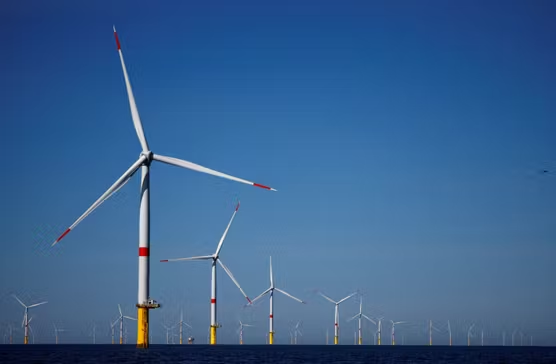
Electricity is expected to play a much larger role in the country’s energy mix, accounting for 55% of total energy consumption by mid-century, compared with 37% in 2023. This shift will be driven primarily by an expansion of renewable energy, supported by continued investment in low-carbon infrastructure.
The announcement comes at a sensitive moment for global climate action. Last month’s COP30 summit in Brazil ended without an explicit international commitment to phase out fossil fuels, despite pressure from the European Union and climate-vulnerable countries.
French officials have positioned the SNBC-3 as evidence that national governments can still push forward, even when multilateral negotiations stall. However, the unveiling of the strategy was met with visible protest in Paris.
Greenpeace activists poured orange paint onto the cobblestones around the Arc de Triomphe, denouncing what they described as “ten years of climate sabotage.” The demonstration underscored the gap between government planning and the demands of environmental groups calling for faster and more binding action.
Public opinion in France remains divided over the lifestyle changes implied by the transition to carbon neutrality. Measures such as reducing meat consumption, purchasing electric vehicles, and flying less have become politically contentious. Far-right parties have criticized the proposals as “punitive environmentalism,” arguing they place an unfair burden on households and rural communities.
The government insists the strategy is compatible with economic growth. Environment Minister Monique Barbut described the plan as an economic and industrial recovery project rather than a set of restrictions on daily life. She stressed that the focus would be on scaling up existing technologies, including heat pumps, renewable power generation, and electric mobility.
Transport remains one of the most challenging sectors. The government hopes that 15% of cars on French roads will be electric by 2030, with near-total decarbonization by 2050. By that point, aviation is expected to be the only remaining mode of transport emitting carbon dioxide, with efforts underway to limit and offset its impact.
Agriculture also features prominently in the updated roadmap. The strategy calls for dietary shifts toward increased consumption of fruits and vegetables, alongside measures to reduce emissions from livestock farming. Farmers will be encouraged to adopt more sustainable practices while maintaining food security and rural livelihoods.
Industry faces a parallel transformation. Heavy manufacturing sectors are expected to cut emissions through cleaner production methods, electrification, and changes in consumption patterns. Officials acknowledge that achieving these targets will require substantial investment, innovation, and social consensus.
As France looks toward 2050, the success of the SNBC-3 will depend not only on policy design but also on public acceptance and political continuity. With climate urgency growing and international momentum uncertain, the roadmap represents both a test of national resolve and a signal of France’s long-term climate ambitions.