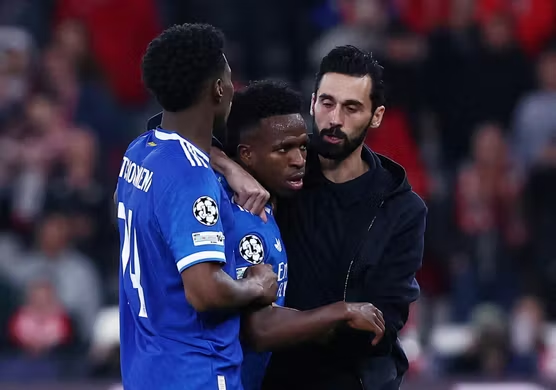
After Real Madrid secured a hard-fought 2-1 victory over Benfica to reach the Champions League last 16, French footballer and Madrid midfielder Aurélien Tchouaméni made it clear the night carried deeper significance.
For Tchouaméni, operating at the heart of Madrid’s midfield, the win represented solidarity against racism rather than just progression in Europe’s elite competition. “This is a victory for everyone who is against racism,” he said calmly after the final whistle.
The tie had already been clouded by controversy. During the first leg in Lisbon, allegations emerged of racial abuse aimed at Madrid forward Vinícius Júnior, an issue that has repeatedly followed the Brazilian throughout his career. The second leg at the Santiago Bernabéu Stadium therefore unfolded under emotional tension as much as tactical pressure.
Madrid entered with a slim advantage but struggled at times to assert dominance. Benfica pressed high, moved the ball quickly, and forced several defensive recoveries. Tchouaméni’s role proved essential.
The French midfielder shielded the back line, broke up attacks, and helped transition play forward, providing stability when the game threatened to tilt away from the hosts. His composure allowed Madrid to regain control during critical phases. Yet the defining moment came through Vinicius.
The Brazilian winger struck Madrid’s second goal with a sharp finish that lifted the stadium. The celebration was raw, filled with relief and defiance after days of scrutiny and headlines. Soon after, large banners reading “No to racism” were displayed around the stands, turning the stadium into a unified statement.
Vinicius later shared the sentiment online, posting a photo of the message with the caption: “The dance continues.” UEFA’s investigation remained a central talking point.
The player accused of directing abuse, Gianluca Prestianni, was provisionally suspended by UEFA ahead of the match. Benfica’s appeal against the ban was rejected earlier in the day, and the case is still under review.
The governing body has not yet announced further disciplinary measures, but scrutiny around discriminatory behaviour in European competitions has intensified. Madrid also took swift action internally.
Club officials confirmed that a supporter was expelled from the stadium before kickoff after performing a Nazi salute. Security staff identified the individual during a television broadcast and immediately removed them.
The club released a statement condemning “gestures that incite hatred and violence,” reinforcing its zero-tolerance stance. Head coach Álvaro Arbeloa praised both the team’s resilience and Vinicius’ response. “I reacted with joy for the goal, and because it was him,” Arbeloa said. “He deserves moments like this.”
The coach emphasized that the players were emotionally invested in more than just qualification, noting the importance of standing together in difficult circumstances. Madrid achieved the result without one of their biggest stars.
Forward Kylian Mbappé missed the match while recovering from a knee injury. Arbeloa described the absence as precautionary, saying the medical staff preferred full recovery over risk.
In Mbappé’s absence, the responsibility shifted to the collective — and to figures like Tchouaméni in midfield. His leadership, quiet but authoritative, helped maintain focus when distractions threatened to dominate the night.
While the scoreboard confirmed Madrid’s progress to the knockout stages, the lasting image was not just of goals or saves. It was of players speaking openly about equality, banners hanging in the stands, and a club determined to confront intolerance head-on.
For Tchouaméni, the message was simple. Football may bring trophies and headlines, but respect and dignity matter more. On a charged European evening in Madrid, that principle defined the victory as much as the scoreline.