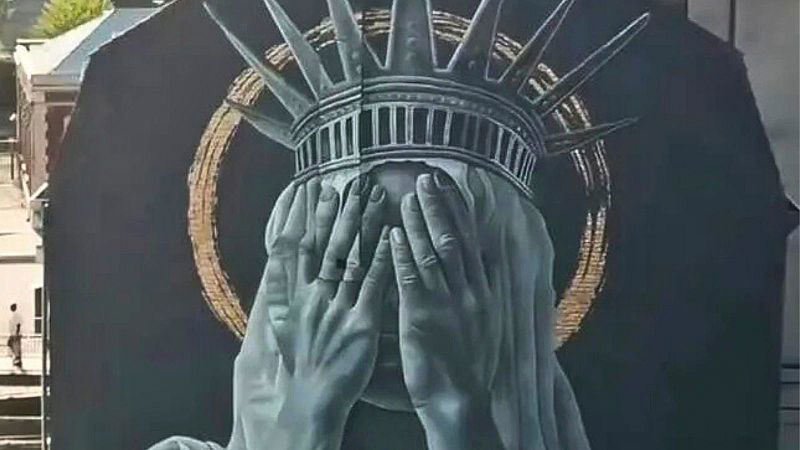
Roubaix, France — A towering mural in northern France has ignited fierce global debate over the United States’ immigration policies after street artist Judith de Leeuw unveiled a haunting depiction of the Statue of Liberty with her hands covering her eyes.
Painted on the side of a building in Roubaix, a town known for its diverse immigrant population, the mural has amassed millions of views online.
De Leeuw, a Dutch street artist based in Amsterdam, described the piece as “a quiet reminder of what freedom should be” — and a bold condemnation of the current trajectory of US immigration under former President Donald Trump.
“I painted her covering her eyes because the weight of the world has become too heavy to witness,” de Leeuw wrote in a Facebook post on July 4, coinciding with American Independence Day. “What was once a shining symbol of liberty now carries the sorrow of lost meaning.”
Roubaix’s deputy mayor for cultural affairs, Frédéric Lefebvre, defended the artwork as “a very strong and powerful political message.” The mural is part of a local urban street culture festival and stands in one of France’s poorest cities — a community with deep immigrant roots, shaped by the collapse of the textile industry since the 1970s.
The Statue of Liberty, gifted by France to the United States in 1886, has long stood as a symbol of freedom and welcome for immigrants arriving in America. De Leeuw’s reinterpretation, however, portrays that ideal as betrayed.
Her mural arrives at a time of mounting global concern over Trump’s revived immigration crackdown. Since returning to political prominence, the former president has pursued aggressive deportation policies, including the controversial removal of migrants to nations with no direct ties to them, such as South Sudan and Eswatini.
Critics of the mural, including Tennessee Republican Representative Tim Burchett, expressed outrage online. “It disgusts me,” he wrote on X (formerly Twitter), citing his uncle’s sacrifice in France during World War II. The backlash underscores the political tension that still surrounds Trump’s legacy and immigration policies.
Despite the criticism, de Leeuw remains defiant. “I’m not offended to be hated by the Donald Trump movement. I am not sorry. This is the right thing to do,” she said in an interview with the Associated Press.
Recent polling from Gallup suggests growing American support for immigration, with fewer respondents backing the mass deportation initiatives Trump has championed.
The Roubaix mural now stands as a potent symbol — not only of artistic protest, but of a deepening divide over the meaning of liberty in the modern world.