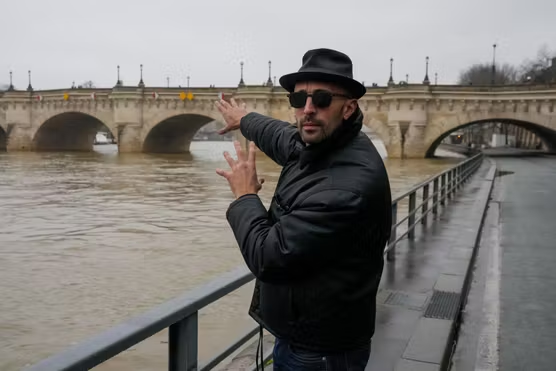
Crowds crossing Paris’ oldest bridge this summer may find themselves slowing to a halt, gazing upward and stepping into what looks like a rocky cavern rising from the Seine. That deliberate pause is exactly what French artist JR hopes to inspire with his latest monumental public artwork.
The internationally known street artist plans to transform Pont Neuf into a vast, immersive “cave” installation that will stretch across the entire structure. Covering the bridge’s stone arches with sculpted, rock-like surfaces, the project will turn the everyday crossing into a sensory tunnel complete with sound effects and augmented reality elements.
Despite its name meaning “New Bridge,” the Pont Neuf dates back to the early 17th century and is widely considered the city’s oldest standing bridge. Normally bustling with tourists and commuters, it connects both banks of the River Seine and offers one of the French capital’s most photographed views.
JR’s installation, titled Pont Neuf Cavern, will run from June 6 to June 28. The temporary structure will measure around 120 meters in length and rise more than 17 meters high, making it one of the largest immersive artworks ever staged in the heart of Paris.
Speaking to Associated Press from his studio in eastern Paris, the artist described the project as potentially “the largest immersive installation ever made.” Accessible around the clock, the cavern will invite visitors to experience the bridge in an entirely different way.
“I want people to stop,” JR said, explaining that the artwork aims to interrupt the city’s relentless pace. Instead of rushing across, pedestrians will be encouraged to wander, listen, and look more closely at their surroundings.
Known for his large-scale photographic collages, murals and participatory street art, JR has built a global reputation for turning public spaces into open-air galleries. Often compared to Banksy, he has created projects from border walls to museum facades, blurring the line between art and activism.
The Pont Neuf transformation, however, carries special emotional weight. The installation doubles as a tribute to the late artistic duo Christo and Jeanne-Claude, whose wrapped monuments redefined public art in the 20th century.
In 1985, the pair famously covered the same bridge in pale golden fabric, wrapping its arches, balustrades and streetlamps in a shimmering sheath. The project took years of negotiation with authorities and became one of Paris’ most iconic cultural moments, drawing millions of visitors.
JR said he had the opportunity to meet Christo several times and felt deep respect for the duo’s approach. Their ability to temporarily alter familiar landmarks, he explained, showed him that public spaces could be reimagined on a grand scale without permanently altering them.
Following in those footsteps is not without pressure. “It’s pretty hard to go after them,” he admitted, noting that comparisons are inevitable. Still, he insists his approach differs both visually and conceptually.
Where Christo and Jeanne-Claude wrapped the bridge in fabric, JR plans to give it a geological illusion. From a distance, the Pont Neuf will appear swallowed by a prehistoric rock formation, as though nature had reclaimed the structure. Up close, visitors will walk through textured surfaces resembling stone and mineral layers.
The project also incorporates digital elements. Augmented reality features accessible through smartphones will add hidden visuals and soundscapes, deepening the illusion of entering a cave. The aim, JR says, is to merge ancient natural imagery with modern technology.
City officials see the installation as part of a broader push to animate public spaces through culture. Temporary artworks have become increasingly popular in Paris, drawing both residents and tourists while avoiding long-term construction or environmental impact.
Still, transforming such a historic monument presents logistical challenges. Engineers and heritage experts are working to ensure the structure remains untouched beneath the installation. Everything will be removable, leaving the bridge exactly as it was once the project ends.
For JR, that ephemerality is central. Like much of his work, the cavern will exist only briefly before disappearing, preserved mainly through photographs and memories.
By turning a daily commute into an unexpected journey, the artist hopes to create a shared experience that reshapes how Parisians see their city.
For three weeks in June, the Pont Neuf will no longer simply connect two banks of the Seine. It will become a destination in itself — a cave in the middle of Paris, inviting people to slow down and step inside.