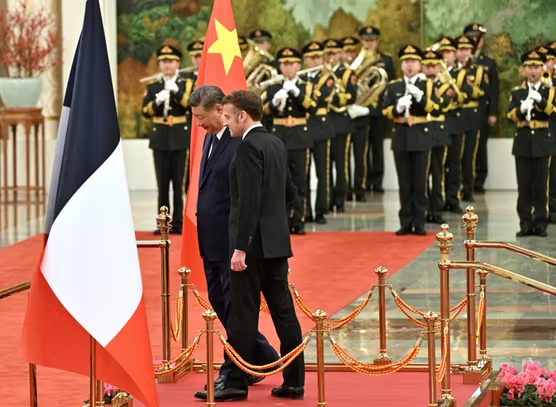
French President Emmanuel Macron urged Chinese leader Xi Jinping to play a more decisive role in ending the war in Ukraine and to help rebalance economic ties as the two leaders met in Beijing on Thursday, December 4.
Arriving at the Great Hall of the People for the first full day of his three-day visit, Macron received a grand ceremonial welcome. Xi and First Lady Peng Liyuan greeted Macron and his wife Brigitte with military honors, music, and rows of children waving French and Chinese flags. The warm reception underscored Beijing’s desire to project stability in its relations with Europe despite ongoing tensions.
Macron, now on his fourth official visit to China as president, views the trip as a critical opportunity to revive momentum toward a ceasefire in Ukraine. The conflict, approaching its fourth year, remains the most devastating war on European soil since World War II. European leaders fear that prolonged instability risks reshaping the continent’s security architecture and diminishing faith in global governance based on the rule of law.
In his opening remarks, Macron stressed the urgency of cooperation. He told Xi that France and China “must overcome differences” to confront shared global challenges. According to Macron, the path to restoring peace in Ukraine requires the engagement of all major international players, including Beijing, whose influence over Moscow remains substantial.
China has maintained a publicly neutral position since the start of the war, calling for dialogue while avoiding outright condemnation of Russia. Xi reiterated that stance during their meeting, saying China supports “all efforts committed to peace” and hopes negotiations will lead to a “fair, lasting and binding agreement acceptable to all parties.”
Macron has emerged as a vocal proponent of renewed diplomatic efforts. In recent weeks, he has spearheaded a European push that aims to counter a separate US-backed plan criticized by some governments for aligning too closely with Moscow’s demands. His Beijing visit is part of a broader attempt to rally support for a ceasefire proposal grounded in international law and European security concerns.
Beyond the war, economic issues weighed heavily on Macron’s agenda. France’s trade deficit with China reached €46 billion in 2024, reflecting long-standing concerns about market access, subsidies, and industrial competition. Macron pressed Xi for greater openness to French and European companies, warning that persistent trade imbalances could deepen political distrust between the two sides.
China, facing slowing growth and international skepticism, has signaled interest in stabilizing economic ties with Europe amid ongoing tensions with the United States. Xi echoed Macron’s call for “more stable” relations and emphasized that cooperation, rather than rivalry, should define the future of the partnership.
Officials accompanying Macron noted that the talks also touched on broader global issues, including climate challenges, strategic security, and the need for more resilient supply chains. Both sides pledged to continue high-level dialogue as they navigate a complex geopolitical environment marked by war, economic uncertainty, and shifting power dynamics.
While significant breakthroughs remain uncertain, the symbolism of the visit—and Xi’s willingness to engage directly on Ukraine—signals that Beijing may be open to playing a more visible role in diplomatic efforts. For Macron, strengthening Europe’s voice while maintaining open channels with China remains key to achieving both peace and economic balance.
As the French leader continues his visit, attention will focus on whether the renewed dialogue can translate into concrete steps toward easing one of the world’s most dangerous conflicts and recalibrating a major global economic partnership.