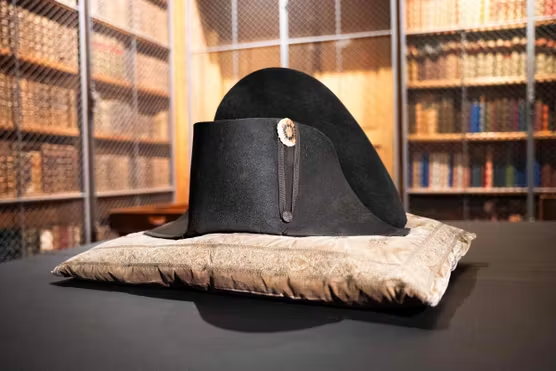
France, Hauts-de-France: Newly authenticated Napoleon bicorne from Saint Helena exile to be displayed at Château de Chantilly, revealing rare historical insights
A remarkable discovery from one of history’s most iconic figures is set to captivate historians and the public alike, as a long-lost hat believed to have belonged to Napoleon Bonaparte during his exile has been authenticated and prepared for exhibition in France.
The black felt bicorne, associated with the former French emperor’s final years on the remote island of Saint Helena, was unveiled to the media on March 26.
It will be displayed later this year at the Château de Chantilly, located just north of Paris, where it is expected to draw significant attention from scholars and enthusiasts of Napoleonic history.
Historians have described the find as extraordinary, not only because of its rarity but also due to its remarkable state of preservation. Mathieu Deldicque, director of the Condé Museum, where the hat will be exhibited, called the discovery a “true miracle,” emphasizing that nearly every element of the artifact remains intact.
“This hat is a revelation,” Deldicque said during the presentation. “We know every stage of its history, from Napoleon’s exile on Saint Helena right up to the present day.” His comments highlight the unusually well-documented journey of the object, which has long remained hidden from public knowledge.
The hat’s authenticity was confirmed by Jean-Guillaume Parich, a specialist from the Army Museum. According to Parich, the bicorne is one of four hats that Napoleon took with him into exile after his defeat and subsequent abdication. The emperor was exiled to Saint Helena in the South Atlantic, where he spent the final years of his life until his death in 1821.
Parich noted that the hat offers a deeply personal connection to Napoleon’s final days. Among the most striking features are signs of wear that provide insight into the emperor’s daily life. “There are even some rather moving details,” Parich explained, pointing to the silk lining. “It shows clear signs of perspiration. One can really picture the emperor in his final years.”
Napoleon’s bicorne hats were a defining aspect of his image. Unlike most military officers of his time, who wore their hats front-to-back, Napoleon famously wore his sideways. This distinctive style allowed his troops to easily identify him on the battlefield, contributing to his iconic silhouette.
The rediscovered hat was crafted by Poupard, Napoleon’s official hatmaker, and features all the characteristics of an authentic imperial bicorne. These include its unique proportions, a small tricolor cockade, and a silk-taffeta lining. Historians estimate that Napoleon commissioned between 60 and 80 such hats during his lifetime.
Despite the number originally produced, only a small fraction have survived. Parich stated that around 15 of these hats have been fully authenticated and are currently held in museum collections around the world. This newly confirmed example adds to that limited group, further enhancing its historical significance.
The journey of the hat after Napoleon’s death adds another layer of intrigue. In his will, the emperor left several personal belongings, including two of his final hats, to his son, Napoleon II, also known as the King of Rome. However, these items never reached him. Napoleon II died in 1832 from a lung infection, leaving the fate of many imperial relics uncertain.
In 1836, the imperial estate brought back from Saint Helena was awarded to Napoleon’s sister, Caroline Murat. Over time, the hat eventually became part of the Condé Museum’s collection in 1904. However, rather than being displayed, it was placed in storage, where it remained largely forgotten.
For decades, the artifact was unknown even to specialists in the field. Its rediscovery came only recently, in 2025, during preparations for an upcoming exhibition. It was then that Parich successfully traced the hat’s provenance and confirmed its authenticity through detailed analysis.
The upcoming exhibition at the Château de Chantilly is expected to provide visitors with a rare opportunity to view the hat up close. Museum officials say the display will place the artifact within the broader context of Napoleon’s life, particularly focusing on his years in exile.
Napoleon’s time on Saint Helena has long fascinated historians. Isolated and far from the centers of power he once commanded, the former emperor lived under British supervision while reflecting on his legacy. Personal objects from this period are especially valuable, as they offer a more intimate perspective on a figure often associated with grand military campaigns and political ambition.
The hat’s rediscovery also underscores the importance of museum collections and the potential for overlooked artifacts to yield new historical insights. Deldicque emphasized that such finds remind scholars and institutions of the need to continually reexamine existing collections.
“This discovery shows that even in well-established collections, there are still treasures waiting to be uncovered,” he said.
Experts believe the exhibition will not only attract historians but also a wider audience interested in European history. Napoleon remains a figure of enduring fascination, with his life and legacy continuing to inspire books, films, and academic research.
As preparations for the display continue, anticipation is building around what many are calling one of the most significant Napoleonic discoveries in recent years. The hat, once tucked away in storage and forgotten, is now set to take center stage, offering a tangible link to one of history’s most influential leaders.
For visitors to the Château de Chantilly, the exhibition promises more than just a glimpse of an artifact. It offers a chance to connect with the personal story of a man whose impact on history remains profound.
This article was created using automation technology and was thoroughly edited and fact-checked by one of our editorial staff members