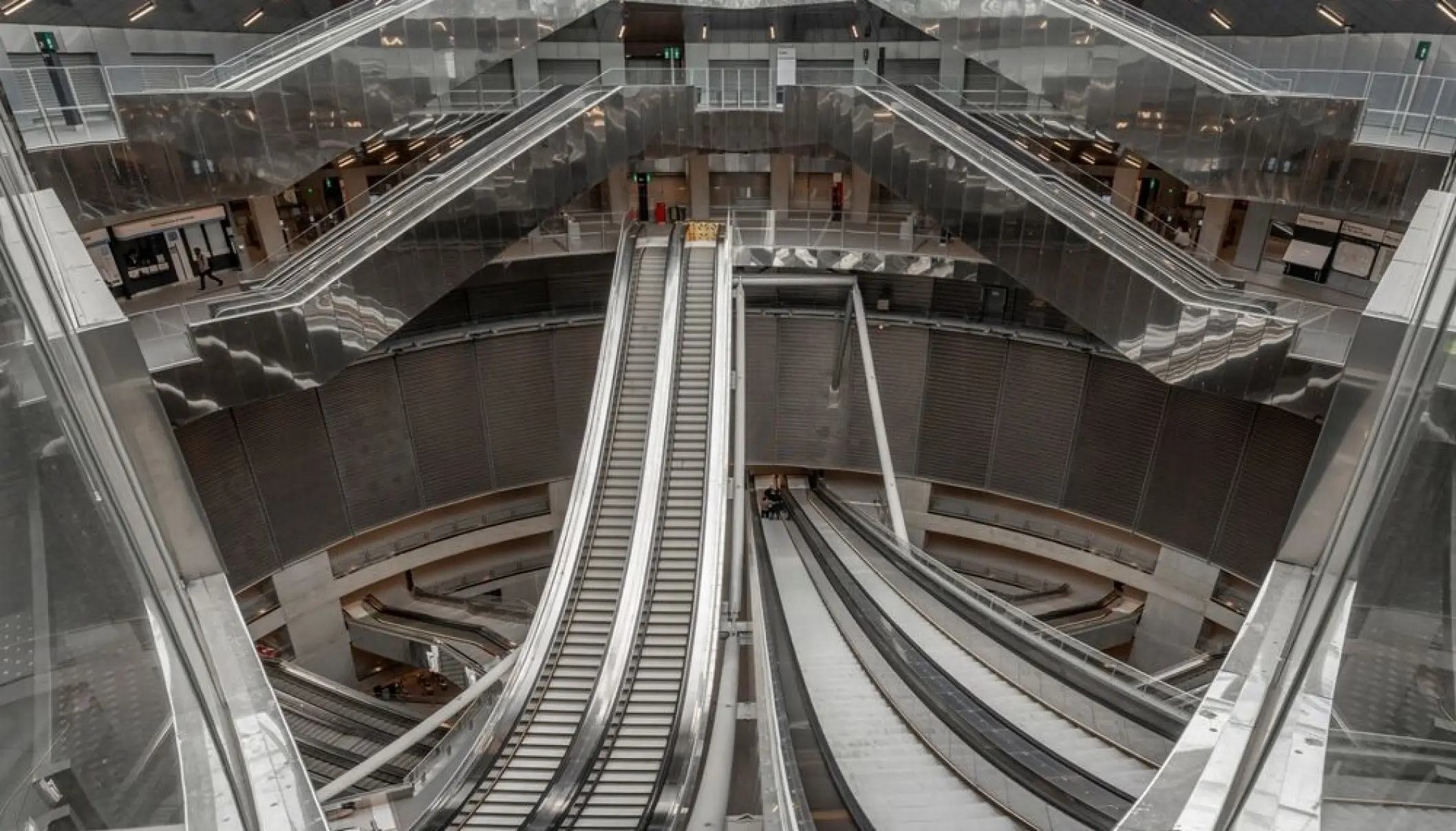
A newly opened station on Paris’s Métro Line 14 has been crowned the most beautiful in the world, earning top honours at the 2025 Prix Versailles, the international architecture award supported by Unesco.
Villejuif-Gustave Roussy station, which welcomed its first passengers in January 2025, topped the global ranking in the “Gares et Stations” category, placing it among the most acclaimed transport buildings worldwide.
The award positions the station as the flagship achievement of the Grand Paris Express, the vast infrastructure programme transforming public transport across the Île-de-France region with new lines and landmark stations.
Located 50 metres underground in the Campus Grand Parc eco-district, Villejuif-Gustave Roussy is currently the deepest station in France, a distinction that posed significant architectural and technical challenges.
The station was designed by renowned French architect Dominique Perrault, best known for large-scale cultural and civic projects that emphasise light, space and material innovation.
Its defining feature is a monumental central glass canopy at street level, which channels natural daylight deep into the station, reaching the concourse and platforms far below ground.
This vertical openness is reinforced by a vast 70-metre-wide central void, deliberately left partly empty to prevent the feeling of confinement typical of deep-level transit hubs.
Stainless-steel walls with polished and satin finishes line the cavernous chamber, amplifying incoming light and creating constantly shifting reflections as passengers move through the space.
The jury of the Prix Versailles praised the station’s exceptional balance of scale, clarity and technical ambition, highlighting how engineering constraints were transformed into expressive architectural elements.
Designed to handle up to 100,000 passengers per day, the station’s circulation system is equally ambitious, with 32 escalators and 16 lifts connecting its multiple underground levels.
Among them are two escalators extending 40 metres in height, underscoring the vertical journey that defines the station experience from street level to platform.
Art has also been integrated into the fabric of the station, reinforcing its cultural as well as functional role within the expanding Paris transport network.
At level minus one, a solar-clock installation by Dominique Perrault and Chilean artist Iván Navarro forms one of the site’s most striking features.
The artwork is composed of 58 illuminated boxes using mirrors, neon elements and astronomical names, creating what designers describe as a cosmic visual effect within the underground space.
Beyond its aesthetic impact, the heavy use of natural light is intended to reduce energy consumption and improve passenger comfort, aligning with broader sustainability goals of the Grand Paris Express.
The new transport system is one of Europe’s largest infrastructure projects, with 68 new stations planned across the region over the coming years.
Villejuif-Gustave Roussy’s international recognition reflects the strategy of using architecture and design excellence to redefine everyday public transport experiences.
Another Line 14 station, Saint-Denis-Pleyel, was also shortlisted in this year’s Prix Versailles, underlining the global attention now focused on France’s metro expansion.
Elsewhere in France, several projects featured in the 2025 awards, demonstrating the country’s strong presence across multiple architectural categories.
In the Restaurants category, Ducasse Baccarat in Paris won first prize, while Nice’s Hôtel du Couvent received a special interior design award in the Hotels category.
Marseille-Provence Airport’s Terminal 1 and the Colisée in Chartres were both honoured with special interior prizes, the latter recognised for its green roof and role as a key sports venue in a smaller city.
Together, these awards highlight how France is leveraging design, sustainability and technical innovation to shape public spaces that resonate far beyond their immediate urban context.
This article was created using automation technology and was thoroughly edited and fact-checked by one of our editorial staff members