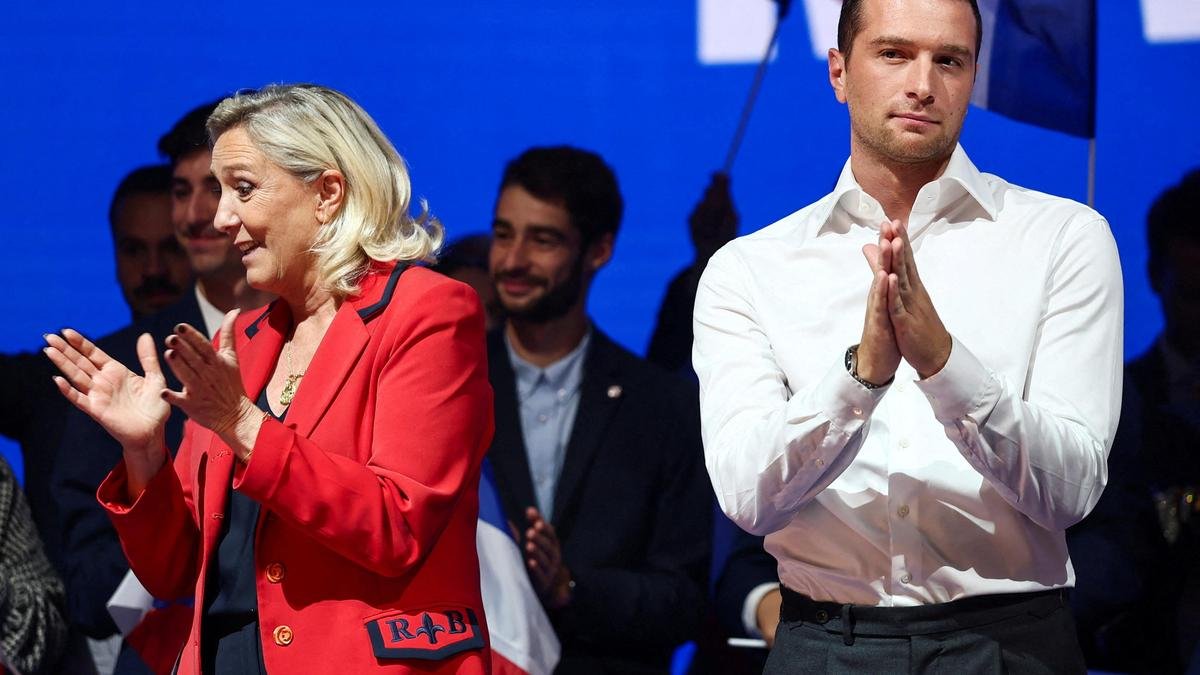
French politics took a sharp turn this week as a groundbreaking Odoxa poll predicted that 30-year-old far-right leader Jordan Bardella would win the 2027 presidential election, regardless of who stands against him.
The findings mark the first time the pollster has projected such dominance for the National Rally (RN) president, signalling a profound reshaping of the French political landscape.
Conducted on November 19 and 20 among 1,000 respondents, the Odoxa survey placed Bardella at 35–36 percent in a hypothetical first-round vote.
This would position him far ahead of rivals from the left, centre, and traditional right, reflecting a surge in support that surpasses even the popularity once enjoyed by his mentor, Marine Le Pen.
The poll’s most striking conclusion came in projected second-round matchups. Odoxa found that Bardella would beat every tested candidate, including far-left figure Jean-Luc Mélenchon, moderate leftist Raphaël Glucksmann and former prime ministers Gabriel Attal and Edouard Philippe.
Against Mélenchon, Bardella would secure a landslide 74 percent, the survey showed.
His closest projected contest would be against Edouard Philippe, where the RN leader would still win a narrow but decisive 53 percent—within a margin that confirms a clear advantage.
The findings contrast with a poll from earlier this month which showed Bardella narrowly losing in a run-off against Philippe. The new data indicates a momentum shift that may reflect voter dissatisfaction across the political spectrum, especially following a drop in President Emmanuel Macron’s approval ratings.
Macron’s decision to call a snap general election in mid-2024 has been widely criticised after it resulted in a fragmented parliament unable to form a stable governing coalition.
Analysts say the political paralysis has deepened public frustration and eroded trust in the centrist movement that brought Macron to power.
Odoxa, however, cautioned that early dominance in polling does not guarantee a future victory. “Unfortunately for Jordan Bardella and his supporters, and fortunately for everyone else, being the overwhelming favourite in a presidential election several months before it takes place is no guarantee of success,” the report noted.
History offers strong evidence of this uncertainty. Marine Le Pen and her father Jean-Marie Le Pen each made it to the second round in past presidential elections, only to be defeated by broad coalitions spanning the political spectrum.
The RN’s track record of second-round losses has long been attributed to the so-called “Republican front,” a collective resistance among mainstream parties to prevent the far right from taking national power. Whether such an alliance could form again in 2027 remains unclear in today’s deeply polarised political climate.
Another factor shaping the political calculus is Marine Le Pen’s current legal battle.
In March, a court barred the 57-year-old leader from holding public office for five years after she and members of her party were found guilty of misappropriating European Union funds.
She has appealed the ruling, but if the ban is upheld, Bardella becomes RN’s uncontested presidential candidate.
Bardella’s rise has been rapid and strategically crafted. Since becoming party president, he has embarked on a broad national campaign, presenting himself as a disciplined, modern figure capable of steering France in a new direction.
Polls show his approval rating now exceeds Le Pen’s, indicating a widening generational and stylistic shift within the party’s supporter base.
Political observers say Bardella’s appeal stems from his ability to blend traditional RN themes—such as immigration and security—with messaging aimed at younger voters concerned about purchasing power, public services and economic insecurity.
His polished media presence and relentless public engagement have further strengthened his image as a compelling alternative to the current political establishment.
Despite his strong polling, uncertainty still surrounds the 2027 contest. France’s multi-party system remains volatile, and alliances forged late in campaigns have historically overturned early projections.
Still, the latest Odoxa survey suggests that Bardella’s candidacy is no longer a hypothetical scenario but a formidable force that could redefine the course of French politics.
As the 2027 presidential election draws closer, parties across the political spectrum are expected to recalibrate their strategies. For now, Jordan Bardella stands as the man to beat—an unexpected but undeniable frontrunner in a political landscape undergoing rapid transformation.