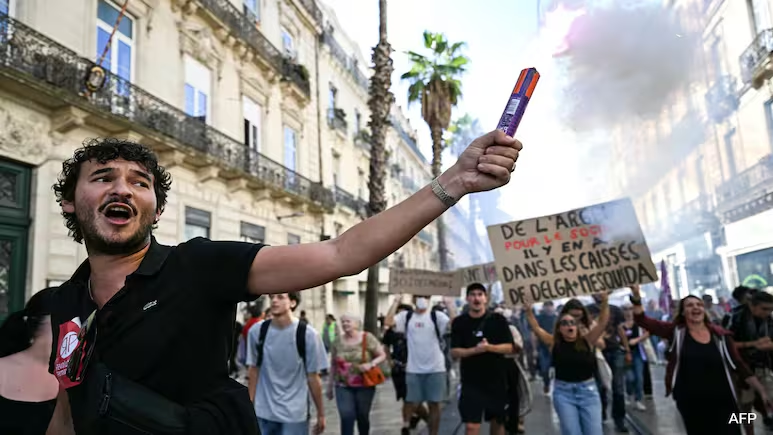
PARIS — A wave of protests swept across France on Wednesday, with demonstrators clashing with police, setting fires, and blocking roads in an attempt to heap pressure on President Emmanuel Macron and his newly appointed prime minister.
The protests, which began online under the slogan “Block Everything,” spread across major cities including Paris, Rennes, and Toulouse. Although the unrest fell short of organizers’ goal of nationwide paralysis, the disruptions were significant enough to test the government’s resolve.
Interior Minister Bruno Retailleau confirmed nearly 200 arrests in the early hours of the demonstrations. He described the protests as an effort to create “a climate of insurrection,” noting that a bus had been torched in Rennes and damage to a power line disrupted train services in the southwest.
Authorities deployed an exceptional 80,000 police officers nationwide, a show of force designed to prevent the kind of uncontrolled unrest that has plagued Macron’s presidency in the past. Police were seen breaking up barricades and firing tear gas to disperse crowds in Paris and other hotspots.
Despite the heavy deployment, sporadic fires, barricades, and clashes marked the capital and regional cities. Protesters accused Macron’s government of ignoring public grievances, with anger directed not only at the president but also at his newly appointed prime minister, who now faces an early political trial by fire.
While the protests were disruptive, observers noted that they lacked the intensity of the Yellow Vest movement that brought months of turmoil during Macron’s first term. More recent memories of unrest, such as riots in 2023 following the police killing of a teenager near Paris, also weighed heavily in the background.
Political analysts suggest that Macron’s challenge lies in balancing firm law enforcement with political dialogue. His government, already weakened by discontent over pension reforms and social inequality, faces a public unwilling to forgive what many view as dismissive leadership.
Retailleau defended the police response, insisting swift action was necessary to avoid escalation. “Our priority is to maintain order and ensure the safety of citizens,” he told reporters. However, critics argue that heavy policing risks inflaming tensions further rather than calming them.
For Macron, the unrest highlights the fragility of his authority in the latter half of his presidency. With growing public fatigue over his policies and leadership style, the protests serve as both a warning and a reminder of the volatility that continues to shadow French politics.
As fires burned and barricades fell, the streets of France once again echoed with defiance — a sign that even after years of turbulence, resistance against Macron’s government shows little sign of subsiding.