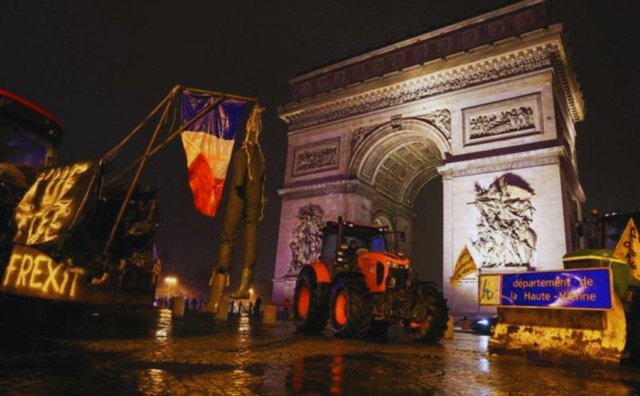
French farmers staged a dramatic large-scale protest in Paris on Thursday, driving convoys of tractors into the heart of the capital and blocking some of its most famous landmarks, including the Arc de Triomphe and sections of the Champs-Élysées.
The demonstrations underscored growing anger within France’s agricultural sector over trade policy and what farmers see as government neglect.
The protest was sparked primarily by opposition to a free trade agreement the European Union is expected to sign with the Mercosur bloc, which includes Brazil, Argentina, Uruguay, and Paraguay.
Farmers fear the deal will open European markets to cheaper agricultural imports, particularly beef, produced under standards they argue are less strict than those imposed on EU producers. Many believe this will drive down prices and further squeeze already fragile farm incomes.
Adding to their frustration is the French government’s handling of a recent outbreak of lumpy skin disease among cattle. Farmers say the response has been slow and insufficient, leaving livestock producers facing uncertainty and financial losses.
For many demonstrators, the trade deal and disease outbreak have become symbols of broader grievances about declining support for rural communities.
Protesters bypassed police checkpoints early in the morning to reach central Paris, catching authorities off guard. Stéphane Pelletier, deputy president of the rightwing Coordination Rurale union in Vienne, described the atmosphere among farmers as one of “resentment and despair.”
He said many feel abandoned by policymakers who, in their view, prioritize sectors such as aerospace and automobiles over agriculture.
The French government reacted sharply to the demonstrations. Government spokeswoman Maud Bregeon told France Info Radio that the blockades were “illegal” and warned that obstructing motorways or assembling near sensitive sites like the National Assembly could lead to legal consequences.
Police monitored the situation closely but initially avoided large-scale confrontations.
The protests come despite recent efforts by the European Commission to calm unrest among farmers across the bloc. Measures announced include the early release of €45 billion in EU agricultural subsidies and reduced import duties on certain fertilizers.
However, many French farmers remain unconvinced, arguing that financial relief does not address what they see as unfair competition embedded in the Mercosur agreement.
Supporters of the deal, including Germany and Spain, and reportedly Italy, argue it would create the world’s largest free-trade area. They say it would significantly boost EU exports of vehicles, machinery, wine, and spirits to Latin America, strengthening Europe’s global trade position.
Approval of the agreement is expected in a vote on Friday, even without France’s backing.
Protests were not limited to Paris. Near Bordeaux, around 40 farm vehicles blocked access to a fuel depot, while earlier demonstrations across France have included road blockades and manure dumped outside government offices.
Belgian farmers staged similar protests in December, bringing around 1,000 tractors to Brussels to oppose the same trade deal.
As tensions mount, French authorities face growing pressure to balance international trade ambitions with the concerns of a powerful and increasingly mobilized farming community.