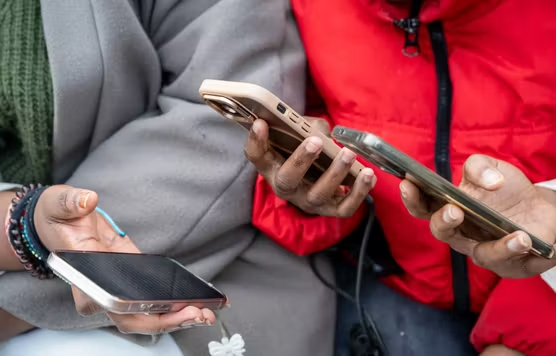
France is preparing to reshape how its youngest citizens use the internet, after lawmakers approved a sweeping measure that will restrict social media access for children under 15. Beginning in September, teenagers will face mandatory age verification checks to log into several of the world’s most popular platforms.
The law, passed in January by the Assemblée Nationale, reflects growing concern among officials over online harms, including cyberbullying, excessive screen time and exposure to inappropriate content. Authorities say the changes are designed to protect minors and encourage healthier digital habits.
Under the legislation, major services such as TikTok, Instagram, Snapchat and Facebook will be required to verify users’ ages before granting access. Certain features on WhatsApp and Roblox may also be restricted.
The policy could disrupt daily life for millions of middle school students who rely on these apps not just for entertainment but for organizing homework, activities and friendships. For many adolescents, social media has become their primary means of communication.
Interviews conducted by Le Monde with several teenagers in the Paris region reveal a mix of resignation, frustration and disbelief.
“I’m not going to cry about it, but it’s going to be less convenient for some things,” said Enola, an eighth-grade student from Vélizy. Like many of her classmates, she uses messaging apps to coordinate group work and after-school plans.
Others were more blunt. Benjamin, 13, said he spends roughly two hours a day on TikTok and Snapchat. “We won’t be able to do anything anymore, we’re going back to the Stone Age,” he said with a laugh. “If we want to play football, what will we do? Send letters instead?”
His comment captures a broader sentiment shared by several teenagers who feel adults are exaggerating the risks. Many argue that social platforms are simply tools, not inherently dangerous spaces.
“Adults are overreacting,” said another student. “They think we’re doing something bad, but we’re just talking with friends.”
Government officials, however, see the issue differently. France’s digital affairs ministry has cited research linking heavy social media use to anxiety, sleep disruption and declining academic performance among children. Policymakers believe limiting access during early adolescence may reduce those pressures.
Supporters of the measure also say age verification could curb exposure to harmful content and online predators. France joins a growing list of countries exploring tighter online protections for minors, as regulators worldwide struggle to balance freedom with safety.
Still, experts warn the policy may face practical hurdles. Age verification technology remains imperfect, and privacy advocates question how companies will collect and store identification data securely. Some teenagers have already said they expect to bypass restrictions using older relatives’ accounts or virtual private networks.
“There will always be workarounds,” said a digital rights researcher based in Paris. “The challenge is ensuring enforcement without invading privacy or pushing young people toward less regulated corners of the internet.”
Parents appear divided. Some welcome the restrictions, hoping they will reduce arguments over screen time. Others worry the ban could isolate their children socially, particularly as so much school communication now happens online.
Teachers have also expressed concern. Many classrooms use messaging groups to share assignments or updates. If students cannot access these tools, schools may need alternative systems.
For the teenagers themselves, the debate feels personal rather than political. Several said they understood the intention behind the law but resented not being consulted.
“It feels like they’re deciding everything for us,” Enola said. “They don’t really know how we use these apps.”
As September approaches, platforms will begin rolling out verification systems, and families will test whether the policy can truly change online behavior. Whether it reduces harm or simply drives teens elsewhere remains uncertain.
What is clear is that France’s digital landscape for young people is about to change dramatically — and for many adolescents, the countdown has already begun.