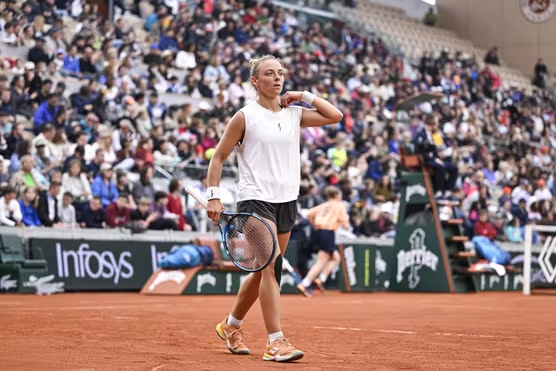
When Alice Tubello finally stood up from the bench on a chilly August evening in Arequipa, Peru, the physical pain of a three-hour loss was quickly eclipsed by something far worse. As she opened her phone, dozens of messages flooded her screen. The content was immediate, graphic and merciless.
“Pathetic whore,” one read. “I hope your arms get broken,” said another. Others went further, invoking death threats and divine punishment. The 23-year-old French tennis player had just lost in a third-set tie-break. For anonymous gamblers online, it was enough to unleash a torrent of abuse.
At the time, Tubello was ranked 219th in the Women’s Tennis Association standings. She was the number one seed, heavily favored by betting platforms, and facing a local player accustomed to high altitude conditions. The loss cost strangers money, and in their eyes, demanded punishment.
More than a year later, Tubello recounts the moment calmly, seated in a shopping center restaurant outside Clermont-Ferrand. Her routine is modest and unglamorous: morning training, conditioning sessions, interclub matches. She now ranks around 430th in the world, fighting for points and financial stability on the margins of professional tennis.
What has not changed is the abuse. “It happens almost every week,” she says. “If you’re favored and you lose, you know what’s coming.” Messages arrive in multiple languages, often within minutes of a match ending, suggesting an organized and global betting culture tracking every point.
Lower-ranked players, unlike stars protected by entourages and publicists, often manage their social media alone. Many rely on online visibility for sponsorships, making it difficult to simply disconnect. Blocking accounts offers limited relief, as new profiles appear quickly and relentlessly.
The rise of legal online gambling has dramatically altered the risk landscape for athletes. Live betting allows wagers on individual games, points or double faults, increasing emotional volatility among gamblers. When expectations collapse, frustration is redirected at players who are visible and accessible.
According to player associations, women and younger athletes are disproportionately targeted. Sexualized insults are common, as are violent threats. Some messages describe graphic harm, decapitation or attacks on family members. While most threats remain virtual, the psychological impact is severe.
Several players interviewed anonymously admit to anxiety, sleep disruption and fear around posting online. Some have sought therapy. Others have temporarily left platforms, sacrificing visibility to protect their mental health. The financial reality of lower-tier tennis makes such choices costly.
Tournament organizers and governing bodies acknowledge the problem but struggle to address it. The global nature of social media complicates enforcement, while betting operators often distance themselves from responsibility, citing individual behavior rather than systemic incentives.
The Women’s Tennis Association has begun monitoring abuse reports more closely and encourages players to document threats. Yet, for many athletes, reporting feels pointless. Few incidents lead to prosecutions, and the burden of evidence collection often falls on the victims themselves.
For Tubello, the most painful aspect is the normalization of the abuse. “You start to think it’s part of the job,” she says. “That maybe you deserve it because you lost.” This internalization, sports psychologists warn, can erode confidence and prolong performance slumps.
Advocates argue that platforms must do more to identify coordinated harassment and block betting-related abuse faster. Some call for limits on live micro-betting or stricter moderation of gambling communities where hostility is amplified.
As professional tennis continues to expand its digital and betting partnerships, players like Alice Tubello remain caught in the middle. Far from center court and television cameras, they compete not only against opponents, but against an online culture that too often treats them as disposable assets.
For now, Tubello keeps training, keeps traveling and keeps her notifications muted after matches. “You love the sport,” she says quietly. “But no one prepares you for this part of it.”
This article was created using automation technology and was thoroughly edited and fact-checked by one of our editorial staff members