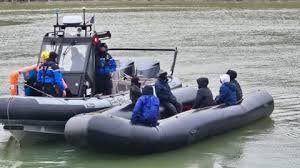
French officials have carried out their first on-water interception under a new policy designed to stop small boats carrying illegal migrants to the United Kingdom, marking a significant escalation in efforts to disrupt people-smuggling operations along the Channel coast.
The operation took place on Saturday on the Aa canal in Gravelines, north of Calais, where French officers boarded a so-called “taxi-boat” suspected of being used to transport migrants towards crossing points.
The canal links inland waterways to the sea, making it a known route for smugglers seeking to avoid detection on beaches.
A photograph obtained by the BBC shows several men, believed to be people-smugglers, on an inflatable dinghy alongside a police launch. The inflatable vessel was subsequently towed back to the dockside following the interception. French authorities have yet to comment publicly on the operation.
The move follows a change in tactics agreed in November, after sustained pressure from the UK government for France to do more to stem the flow of migrants crossing the Channel in small boats.
The revised approach was first outlined at a UK-France summit in July last year, attended by French President Emmanuel Macron and UK Prime Minister Sir Keir Starmer.
Until now, French police had limited their interventions to beaches, stopping boats while they were being prepared for launch. Intervening once vessels were in the water was considered too dangerous, due to the risk of capsizing and potential loss of life.
However, smuggling gangs adapted quickly. They began using “taxi-boats” that enter the water away from heavily policed beaches and then travel along the coast to collect groups of migrants, who wade into the sea to board.
According to official French documents, this method proved highly effective, achieving an estimated 81% success rate in 2025.
Despite extensive patrols and cooperation between the two countries, the number of migrants reaching the UK from France rose last year to 41,472, up from 36,566 in 2024, though still below the record peak of 45,774 recorded in 2022.
Following the July agreement, implementation of on-water interventions was delayed by concerns over officer safety, legal liability, and the potential consequences if migrants were injured or killed during operations.
French officials were particularly wary of the risk of prosecution should an interception go wrong.
Those concerns now appear to have been addressed through revised rules of engagement. Under the new policy, gendarmes are permitted to intercept “taxi-boats” only before they have taken migrants on board, reducing the immediate risk to life.
Saturday’s operation appears to have followed these guidelines. Police suspected the inflatable boat, travelling down the canal towards the sea, was about to be used to collect migrants.
Officers moved in before any passengers were taken aboard, arresting the men on board and preventing the vessel from reaching open water.
The interception signals a more assertive phase in Franco-British cooperation on migration, as both governments face mounting political pressure to show tangible results in tackling dangerous Channel crossings.