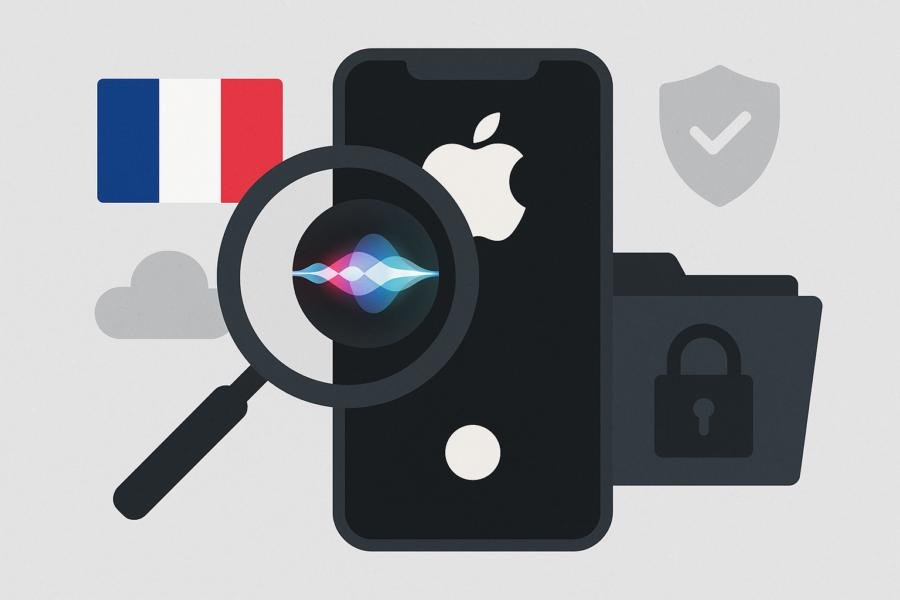
Apple Inc. is under renewed scrutiny in France as prosecutors launch a formal investigation into how the company manages voice recordings gathered through its digital assistant, Siri.
The probe, now referred to the Office for Combating Cybercrime, intensifies Europe’s ongoing efforts to regulate the handling of sensitive personal data by major technology firms.
The case stems from allegations that Apple retained user voice recordings without obtaining adequate consent — a potential violation of the European Union’s strict General Data Protection Regulation (GDPR).
French authorities are now examining whether Apple’s practices comply with privacy standards designed to protect citizens’ digital rights.
Complaint Sparked by Human Rights Group
The investigation follows a formal complaint filed earlier this year by the Ligue des droits de l’Homme (LDH), a French human rights organization. The group argues that Apple’s voice data collection practices may infringe upon users’ right to privacy by retaining and processing recordings beyond their intended use.
According to reports by Politico, which first revealed the probe, the complaint relied heavily on testimony from whistleblower Thomas le Bonniec — a former Apple subcontractor based in Ireland.
Le Bonniec alleged that contractors reviewing Siri recordings were exposed to private and sometimes highly sensitive conversations.
These included personal discussions, medical information, and even intimate exchanges inadvertently captured by Apple devices. Such claims have reignited concerns about the lack of transparency in how AI-driven voice assistants collect and use personal data.
France’s Growing Role in Tech Oversight
French prosecutors confirmed that the investigation has been handed to cybercrime authorities, signaling a growing national determination to confront the challenges posed by digital surveillance and data protection.
France has long positioned itself at the forefront of Europe’s push to rein in the power of global tech giants. In recent years, the French government has pursued a string of actions against multinational technology companies.
These include antitrust investigations and the introduction of a digital services tax targeting major firms such as Google, Amazon, and Meta. The Apple probe adds to this list, underscoring Paris’s readiness to challenge Silicon Valley over user data protection and transparency.
Legal experts note that this latest case could serve as a precedent for how European regulators interpret GDPR provisions in the context of voice-enabled technologies.
How Siri Collects and Uses Data
Siri, Apple’s built-in digital assistant, operates across most of the company’s product lineup, from iPhones and iPads to Macs and the Apple Watch. To improve its accuracy, Siri relies on artificial intelligence models trained on real-world voice interactions.
According to Apple, users must opt in before their audio data is stored and analyzed to enhance Siri’s performance. The company maintains that recordings are anonymized and processed under strict privacy controls.
Apple has stated that audio samples — if collected — may be stored for up to two years.
During that period, external “graders” can review snippets to evaluate Siri’s understanding and response accuracy.
These graders, often employed by third-party contractors, are bound by confidentiality agreements. However, investigators in France are questioning whether Apple’s retention periods and use of external contractors comply with GDPR standards.
The regulation mandates explicit and informed consent before collecting or processing personal information, particularly when it may reveal sensitive details.
Apple’s Response and Policy Updates
In a statement earlier this year, Apple reiterated its commitment to privacy, emphasizing that it “does not retain audio recordings of Siri interactions unless users explicitly opt in to help improve Siri.” Even then, the company stated, the data “is used solely for that purpose.”
Following previous criticism in 2019 over similar issues, Apple temporarily suspended its audio grading program and later relaunched it with new privacy safeguards. Users now receive clearer notifications about data usage and can opt out entirely from contributing recordings.
Despite these measures, privacy advocates argue that the company’s explanations remain insufficient. They stress that even anonymized voice data could be re-identified, particularly if cross-referenced with device identifiers or contextual clues.
French prosecutors will now determine whether Apple’s updated practices genuinely meet the transparency and consent requirements under GDPR.
The Role of Third-Party Contractors
The involvement of external contractors lies at the heart of the French inquiry.
Le Bonniec’s testimony described a system in which subcontractors listened to thousands of daily audio clips, many of which contained private conversations.
He claimed that these recordings were not always properly anonymized, raising ethical and legal questions about whether Apple exercised adequate oversight over its partners.
If investigators conclude that Apple failed to ensure compliance throughout its supply chain, the company could face significant penalties under GDPR, including fines of up to 4% of its global annual revenue.
Such an outcome would not only damage Apple’s reputation but also set a legal benchmark for other voice technology developers.
Wider Context: Europe’s Tech Accountability Push
The French probe unfolds against a broader backdrop of European efforts to strengthen data protection and assert digital sovereignty. Across the continent, regulators have become increasingly assertive in enforcing privacy laws and challenging dominant US tech firms.
The European Commission has imposed billions of euros in fines for antitrust violations and data breaches in recent years. Meanwhile, member states like France continue to advocate for tougher rules on data localization and user consent.
France’s insistence on taxing digital services — a move that previously drew criticism from Washington — further underscores the geopolitical tensions surrounding tech governance.
Former US President Donald Trump once labeled France’s digital tax “discriminatory,” reflecting ongoing disagreements over how global digital revenues should be regulated and taxed.
A Test Case for AI and Privacy
By scrutinizing Apple’s Siri, French authorities are effectively testing how existing privacy laws apply to new generations of AI-driven tools.
Voice assistants, smart speakers, and generative AI systems all rely on vast amounts of user data to function effectively — data that often includes intimate human speech.
The outcome of this investigation could help define future standards for transparency, consent, and accountability in AI technologies across Europe.
Legal analysts expect the case to influence how regulators interpret privacy obligations not only for Apple but also for competitors like Google Assistant and Amazon’s Alexa.
As the investigation progresses, the case stands as a reminder that the balance between innovation and privacy remains one of the most contested frontiers of the digital age.
For now, Apple maintains its silence while the French authorities proceed with their probe — one that could shape the future of voice technology regulation in Europe.