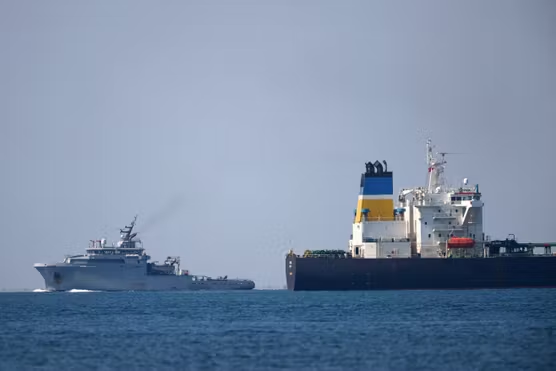
France, Provence-Alpes-Côte d’Azur: Authorities detain санкtioned oil tanker in Marseille as Europe intensifies action against Russia’s covert maritime export network
France has escalated its enforcement of sanctions against Russia by seizing a suspected “shadow fleet” oil tanker in the southern port city of Marseille. The vessel, identified as the Deyna, was taken under control by authorities on Monday, March 23, after being intercepted days earlier in the Mediterranean Sea.
The move reflects growing European efforts to disrupt clandestine oil exports that have continued despite sweeping Western sanctions imposed following Russia’s invasion of Ukraine, now entering its fifth year. Officials say the tanker is part of a broader network used by Moscow to bypass restrictions and maintain revenue streams from oil sales.
According to a joint statement from regional maritime authorities, the 250-meter-long Deyna will remain anchored in Marseille under the supervision of prosecutors as part of a preliminary investigation. The vessel had reportedly departed from Murmansk in northwestern Russia and was sailing under a Mozambican flag at the time of its interception.
French officials confirmed that the tanker is already subject to European Union sanctions. It is the third such vessel detained by France in recent months, signaling a firm stance against what authorities describe as illegal maritime practices linked to Russian oil exports.
The interception of the Deyna took place on Friday near Spain’s Balearic Islands, with assistance from British authorities. Investigators allege irregularities in the ship’s registration documents, a common tactic among vessels in the so-called “shadow fleet.”
This fleet consists of aging tankers operating under obscure ownership structures and frequently changing flags to evade detection. These ships are often uninsured or inadequately maintained, raising concerns not only about sanctions evasion but also about maritime safety and environmental risks.
French President Emmanuel Macron has previously condemned such vessels, describing them as “profiteers of war.” He has pledged to maintain pressure on Moscow despite shifting global attention toward other geopolitical crises, including tensions involving the United States and Iran.
Macron’s remarks come amid criticism of the United States for easing certain restrictions on Russian oil sales. Washington has argued that the move is necessary to stabilize global energy markets, which have been volatile due to ongoing conflicts and supply disruptions.
France, however, has taken a more assertive approach. In January, authorities impounded another suspected Russian-linked tanker named the Grinch. Although the vessel was later released after its owner paid a substantial fine, the incident underscored France’s willingness to act decisively.
A similar case occurred in September when French forces seized the tanker Boracay. Its Chinese captain was later tried in absentia for failing to comply with orders to halt the vessel, highlighting the legal complexities surrounding enforcement actions against international crews and operators.
The crackdown is not limited to France. Across Europe, governments have intensified efforts to identify and detain vessels suspected of participating in Russia’s shadow fleet operations. Belgian special forces recently intercepted a tanker in the North Sea, while Swedish authorities arrested a Russian captain on suspicion of document forgery.
Officials estimate that nearly 600 vessels are currently under European Union sanctions for their alleged involvement in circumventing restrictions on Russian oil exports. These ships form a vast and often opaque network that has proven difficult to regulate.
Experts warn that the persistence of such operations undermines the effectiveness of sanctions and allows Russia to continue funding its war efforts. At the same time, the use of poorly regulated ships poses significant risks to global shipping routes and marine ecosystems.
The Deyna’s seizure is expected to send a strong signal to operators involved in similar activities. By tightening enforcement and increasing cooperation among European nations, authorities hope to dismantle the shadow fleet and close loopholes in the sanctions regime.
Legal proceedings in Marseille will determine the vessel’s fate, including potential fines or further sanctions against its operators. Meanwhile, investigators are likely to examine the ship’s ownership structure, cargo history, and financial links to Russian entities.
As geopolitical tensions continue to reshape global energy dynamics, the battle over Russia’s shadow fleet has become a critical front in the broader effort to enforce international sanctions. France’s latest action underscores the determination of European nations to uphold these measures, even as challenges persist.
This article was created using automation technology and was thoroughly edited and fact-checked by one of our editorial staff members