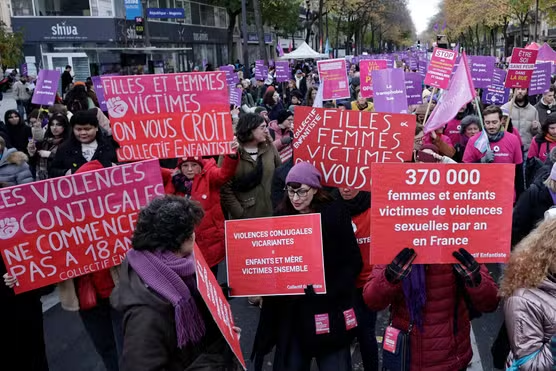
France’s ambitious goal of “the complete elimination of violence against women,” set by President Emmanuel Macron in 2017, ushered in the Grenelle on Domestic Violence — 54 proposed measures aimed at prevention, detection, and punishment of abuse.
On paper, authorities seem mobilized: a cumulative investment of €740.3 million over five years has funded reforms from emergency alert systems to financial support for victim advocacy groups.
Several signature devices have been rolled out across the country. By mid‑2025, there were 6,565 active Téléphones Grave Danger (emergency alert phones) and more than 760 bracelets anti‑rapprochement (restraining‑order bracelets) used to alert authorities if an assailant comes too close.
Legal protections have also expanded: more than 4,200 protection orders were pronounced in 2024 alone, and NGOs have greater access to rapid funding and support services.
Yet advocates and front‑line workers paint a starkly different picture of the situation on the ground.
Services in Crisis
Police stations and victim support organizations — essential to the implementation of the Grenelle’s commitments — are strained by underfunding, staff shortages, and burnout. Despite extensive training campaigns, many officers still lack the practical tools and time to support victims effectively.
The emergency helpline 3919, expanded to 24/7 operation and accessible in multiple languages, logged over 100,000 calls in 2024 but remains overwhelmed in some regions.
Associations report that while more protective mechanisms exist, uneven regional rollout and bureaucratic hurdles mean many victims cannot access help when they need it most. Specialized shelters and legal advocates are stretched thin, often with waiting lists for urgent accommodation.
Rising Figures Highlight Persistent Danger
Official statistics show 272,400 victims of partner or ex‑partner violence recorded by police and gendarmes in 2024, remaining high and only marginally changed from 2023 levels.
Independent groups report dozens of femicides each year, underscoring the stakes of systemic failure. In 2025, at least 96 femicides were recorded by one organization — a number that activists say could be higher under broader counting criteria.
Gaps Between Policy and Practice
Some key measures, like the electronic restraining‑order bracelets, are touted as innovations but face limited judicial use, as judges apply them only in specific cases, reducing their reach.
Legal experts also note that strict proof requirements for protection orders and delays in judicial processing can leave victims exposed.
The difficulty of evaluating nationwide consistency in protective practices suggests uneven implementation across regions.
Calls for a Coordinated System
Critics argue France needs a more centralized risk assessment and monitoring system, similar to Spain’s VioGén model, which has shown reductions in femicides over two decades. But political hesitation and tight budgets hinder such reforms.
Civil society groups also call for sustained funding for grassroots organizations, warning that short‑term budget boosts followed by cuts undercut long‑term stability in victim support.
Looking Forward
The government maintains that continued investment and refinement of Grenelle measures remain priorities, with some outstanding reforms slated for completion in 2025.
However, for many victims and their advocates, gaps between policy intent and protective outcomes demand not just more resources, but structural change to ensure that ambitious goals translate into real safety for women across France.
This article was created using automation technology and was thoroughly edited and fact-checked by one of our editorial staff members