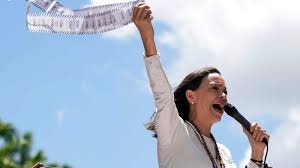
Venezuelan opposition leader Maria Corina Machado was absent from the Nobel Peace Prize ceremony in Oslo on Wednesday, as uncertainty over her whereabouts deepened amid increasing pressure from the government of President Nicolas Maduro.
The Nobel Institute confirmed that Machado, who has lived in hiding for over a year, was unable to travel to Norway despite efforts to attend the event.
Nobel Institute spokesperson Erik Aasheim told AFP that Machado “is not coming to the ceremony,” hours before the event began at Oslo City Hall in the presence of King Harald, Queen Sonja, and several Latin American leaders including Argentina’s President Javier Milei and Ecuador’s President Daniel Noboa.
Officials said it remained unclear whether Machado had even been able to leave Venezuela, where she has faced a decade-long travel ban and escalating threats.
Kristian Berg Harpviken, director of the Nobel Institute and permanent secretary of the award committee, said he did not know Machado’s current location. “She is unfortunately not in Norway and will not stand on stage at Oslo City Hall at 1 p.m. when the ceremony starts,” he told Norwegian broadcaster NRK.
Despite her absence, the ceremony proceeded as scheduled, with Machado’s daughter, Ana Corina Sosa Machado, stepping in to accept the award and deliver the Nobel lecture on her behalf.
The Nobel Institute said this is customary when laureates cannot attend due to political restrictions, imprisonment, or other constraints.
Machado, 58, dedicated the prize in October partly to former U.S. President Donald Trump, whose administration has maintained a hardline stance against Maduro. Trump has claimed he deserves the Nobel Prize himself, while Maduro accuses Washington of seeking to overthrow him to control Venezuela’s vast oil reserves.
The opposition leader aligned herself with U.S. hawks who argue that Venezuela’s government has ties to criminal networks that threaten American national security—claims questioned by U.S. intelligence agencies.
The Trump administration has launched more than 20 military strikes in recent months against alleged drug-trafficking vessels in the Caribbean and the Pacific, actions condemned by human rights groups and some governments as extrajudicial killings.
Machado went into hiding in August 2024 after a disputed presidential election in which she was barred from running despite winning the opposition primary. International observers and opposition groups maintain that their candidate won the election, offering ballot-level evidence to support the claim, while Venezuela’s electoral authorities declared Maduro the victor.
The Nobel Peace Prize has amplified global attention on Venezuela’s democratic crisis. Christopher Sabatini, a senior fellow for Latin America at Chatham House, said the award sends “a strong signal of international validation” for the opposition’s claims. It also elevates Machado, he noted, as a figure “the international community and the world can hang their hopes on.”
“Democratic movements often need a face,” Sabatini said. “They need a story.” Machado’s continued absence – and the mystery surrounding her whereabouts – has now become part of that story, underscoring the risks facing opposition leaders in Venezuela today.