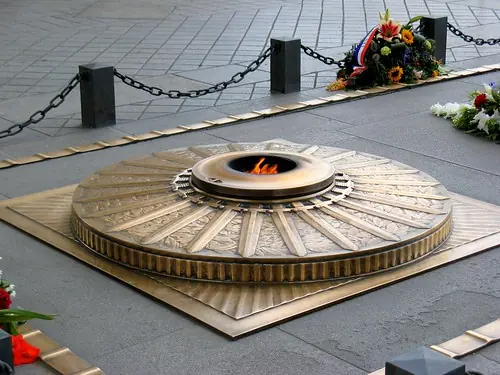
A suspended prison sentence handed to a man in Paris for lighting his cigarette with the Eternal Flame of the Arc de Triomphe has ignited widespread debate in France, drawing criticism from commentators who accuse the State of dramatizing an incident of little consequence.
The case involved a man who admitted to using the flame, which burns in memory of the Unknown Soldier, to light his cigarette. A Paris court sentenced him to three months in prison, suspended, after he expressed regret and described the act as “the mistake of the century.”
For many, the punishment seemed disproportionate to the act. The Eternal Flame, inaugurated in 1923, is one of France’s most revered national symbols, guarded daily and rekindled each evening in a solemn ceremony.
Respect for the site has long been viewed as part of the country’s collective memory, particularly in honoring soldiers who died for France.
Yet critics argue that criminalizing the act reflects an overreach by the State. Writing in Le Monde, one commentator recalled attempting a similar stunt in the early 1980s, when, after a playful dare, he sought to light a cigarette at the flame.
At the time, he was merely stopped by a guard and told to leave. “Things have changed,” he reflected, suggesting that France’s approach to enforcing symbolic respect has grown heavier.
The episode has also highlighted broader questions about how symbolic acts are policed in public spaces. “There are certain taboos which reinforce social cohesion,” said one Paris-based sociologist. “But the question is whether such enforcement should involve the criminal justice system, or if social disapproval alone suffices.”
Supporters of the court’s decision argue that the Eternal Flame must be protected as more than a tourist attraction. Veterans’ groups have often expressed concern about diminishing respect for the site, citing past incidents of vandalism.
“This is not a trivial act,” said a spokesperson for the Association of Veterans of France. “The flame represents sacrifice. Disrespecting it, however small the act may seem, undermines collective memory.”
Others, however, see the case as a distraction from more pressing issues. “To waste the court’s time and taxpayer money on this is to dramatize a non-story,” wrote the commentator. “France has more urgent matters than sentencing someone for a cigarette.”
The incident has resonated widely on social media, where users are split between condemnation of the man’s act and criticism of the severity of the punishment. For some, it reflects a broader shift in France’s sense of security and the State’s reliance on symbolic enforcement to project authority.
As France continues to wrestle with questions of national identity, memory, and respect for tradition, the flame at the Arc de Triomphe has once again become a powerful—if unexpected—flashpoint in the country’s cultural debate.
This article was created using automation technology and was thoroughly edited and fact-checked by one of our editorial staff members