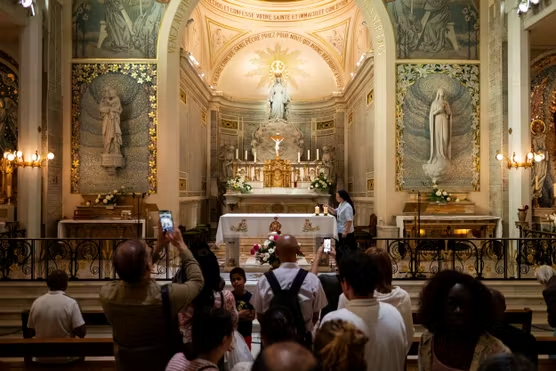
On Rue du Bac, in the heart of Paris’s elegant 7th arrondissement, long lines of visitors form quietly each day outside a modest chapel. Rolling suitcases rest against the walls, cameras hang from shoulders, and whispered prayers mix with multiple languages.
The Notre-Dame-de-la-Médaille-Miraculeuse, better known as the Chapel of Our Lady of the Miraculous Medal, has become an essential stop for millions of international visitors. Many arrive with precise intent rather than curiosity, having planned their visit long before setting foot in Paris.
Pilgrims from Brazil, Mexico, Spain, Italy, the Philippines and beyond now outnumber casual tourists. Unlike many Paris landmarks, almost no one wanders in by chance. The chapel’s reputation travels through family stories, religious books and, increasingly, social media.
For Olga, a 60-year-old visitor from Guatemala, the chapel was non-negotiable. “Everyone I know who has been to Paris came here,” she said, explaining that the site’s importance is widely known in her home country.
Others trace their connection back decades. Maria, a Mexican tourist in her fifties, recalled learning about the Miraculous Medal in childhood. A recent online video revived that memory and convinced her the visit was essential.
The chapel’s growing visibility has translated into astonishing numbers. According to Father Alexis Cerquera Trujillo, the rector of the site, around three million people are expected to pass through the doors in 2025 alone. That figure represents a dramatic rise over the past decade.
“Ten years ago, we welcomed roughly half as many visitors,” the Colombian priest said. The chapel now rivals some of Paris’s most famous cultural institutions, matching attendance figures seen at the Musée d’Orsay and surpassing the ticketed Sainte-Chapelle.
Unlike museums or monuments, entry to the chapel is free. Its appeal lies not in architectural grandeur but in spiritual significance. The site is linked to the 1830 visions of Saint Catherine Labouré, whose experiences inspired the creation of the Miraculous Medal, a devotional object worn by millions of Catholics worldwide.
Inside, the chapel remains relatively small and carefully maintained. Visitors move slowly through the pews, pausing in silence or kneeling in prayer. Volunteers gently guide the flow, ensuring that religious practices coexist with the constant influx of tourists.
The chapel’s success has also reshaped its surroundings. Shopkeepers along Rue du Bac report increased foot traffic, with religious souvenir stores and nearby cafés benefiting from the steady stream of pilgrims. Even upscale retailers across the street have noticed the impact.
This surge highlights a broader shift in global tourism. Faith-based travel, once overshadowed by cultural sightseeing, is experiencing renewed momentum. Travelers increasingly combine traditional landmarks with deeply personal spiritual destinations.
Paris, long associated with art, fashion and gastronomy, is quietly reinforcing its role as a major center of religious heritage. While Notre-Dame Cathedral remains the city’s most iconic symbol of faith, smaller sites like Rue du Bac are now drawing comparable international attention.
The chapel’s global reach is amplified by digital platforms. Videos, livestreamed masses and online testimonies have introduced the Miraculous Medal to new generations, turning personal devotion into global visibility.
Despite the crowds, clergy emphasize that the chapel’s mission has not changed. “People come here seeking peace, healing or gratitude,” Father Cerquera Trujillo said. “Our role is to preserve a place of prayer, not a tourist attraction.”
Balancing spirituality with mass attendance remains a challenge. Quiet hours, clear signage and volunteer coordination help maintain an atmosphere of reverence. Visitors are encouraged to respect silence, even as queues stretch outside.
For many pilgrims, the chapel visit becomes one of the most memorable moments of their Paris trip. Amid packed itineraries of museums and monuments, Rue du Bac offers something different: a pause from spectacle in favor of reflection.
As international travel continues to rebound, the Chapel of the Miraculous Medal appears set to remain a central stop on the global pilgrimage map. What was once an almost unknown Paris chapel has become a powerful symbol of faith-driven tourism in the modern age.